
13.01.2026
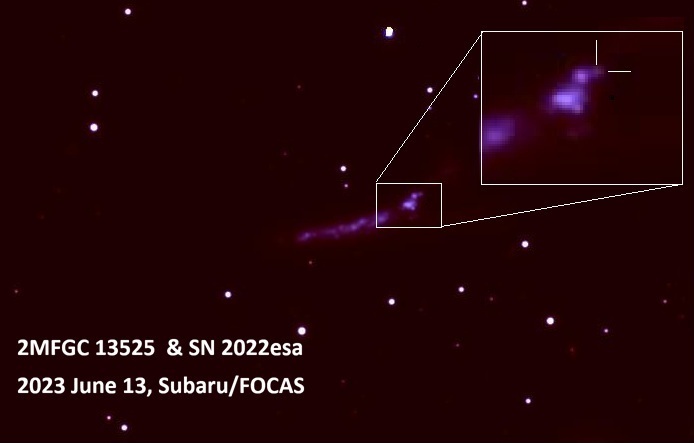
The image of the supernova SN 2022esa (marked by the cross) with its host galaxy, 2MFGC 13525, taken by the Subaru telescope on 2023 June 13. At this late phase (about a year after the discovery), the SN became fainter than its initial brightness by more than a factor of 100. The spectral identity of SNe Ic-CSM can be extracted only in such a late phase in most cases, requiring dedicated observations with 8 meter-class telescope such as the Subaru telescope. (KyotoU / Keiichi Maeda)
Kyoto, Japan -- What we know of the birth of a black hole has traditionally aligned with our perception of black holes themselves: dark, mysterious, and eerily quiet, despite their mass and influence. Stellar-mass black holes are born from the final gravitational collapse of massive stars several tens of the mass of our Sun which, unlike less massive stars, do not produce bright, supernova explosions.
Or at least, this is what astronomers had previously thought, because no one had observed in real time the collapse of a massive star leading to a supernova and forming a black hole. That is, until a team of researchers at Kyoto University reported their observations of SN 2022esa.
The Kyoto team had wondered whether all massive stars -- those that are at least 30 times the mass of the Sun -- die quietly without a supernova explosion, or if in some cases they are accompanied by an energetic and bright, special type of supernova explosion. The astronomers then discovered a type Ic-CSM class supernova that appeared to be an explosion of a Wolf-Rayet star, which are so incomprehensibly massive and luminous that astronomers believe them to be the progenitors of black hole formation.
To investigate the nature of this peculiar supernova, the research team utilized both the Seimei telescope in Okayama and the Subaru telescope in Hawaii. The team was able to observe and classify SN 2022esa as an Ic-CSM type supernova, demonstrating that the birth of a black hole is not necessarily quiet since this one could be observed with electro-magnetic signals.
They also discovered something else: the supernova shows a clear and stable period of about a month in its light-curve evolution, leading the team to conclude that it had been created by stable periodic eruptions of the star system once each year before the explosion. Such stable periodicity is only possible in a binary system, so the progenitor must have been a Wolf-Rayet star forming a binary with another massive star, or even a black hole. The fate of such a system, they determined, must be a twin of black holes.
"The fates of massive stars, the birth of a black hole, or even a black hole binary, are very important questions in astronomy," says first author Keiichi Maeda. "Our study provides a new direction to understand the whole evolutional history of massive stars toward the formation of black hole binaries."
This study also demonstrates the benefits of using two different telescopes that possess different observational properties. In this case, Seimei's flexibility and promptness combined with Subaru's high sensitivity proved to be an effective combination. The team plans to continue conducting research utilizing both telescopes in the coming years.
"We expect many interesting discoveries on the nature of astronomical transients and explosions like supernova," says Maeda.
Quelle: KYOTO UNIVERSITY