
12.01.2026
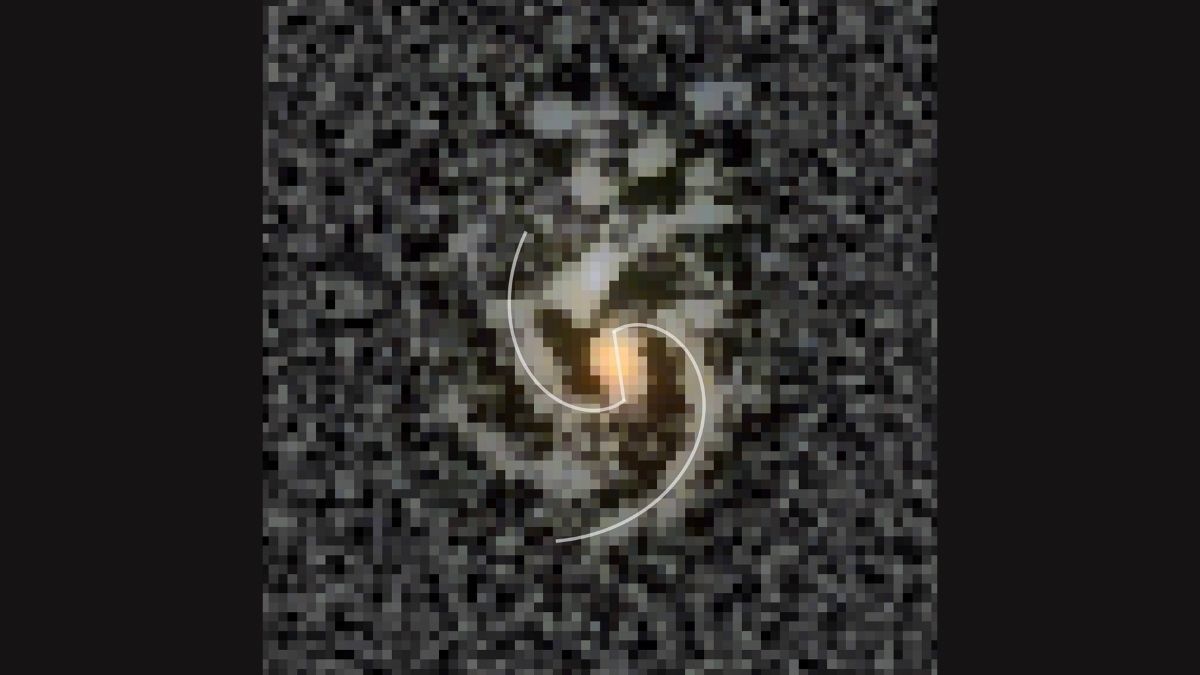
The galaxy COSMOS-74706. Credit: Daniel Ivanov et al.
Researchers from the University of Pittsburgh in the US have found what could be one of the earliest examples of a barred spiral galaxy from 11.5 billion years ago.
Stellar bars are a striking feature of many spiral galaxies, like the Milky Way. When observed perpendicular to the galaxy’s disk, the dense collection of stars and gas appears like a bright line bisecting it.
“Bars are very important because they reflect key features of the gravitational potential and of the dynamics of disk galaxies,” says observational astronomer Mauro Giavalisco from the University of Massachusetts Amherst, USA.
“Their conceptual importance in our understanding of gravitational systems is highlighted by the fact that they are very common in the present-day universe among disk galaxies – and yet we do not fully understand the conditions for bar formation.”
Stellar bars are density waves that form due to instability in a galaxy.
This can be triggered by gravitational forces caused by something outside of the galaxy.
“If you have a close interaction with a nearby galaxy, that can actually trigger the global instability that leads to the formation of a stellar bar,” says Daniel Ivanov, a graduate student in the department of physics and astronomy at the University of Pittsburgh who led the research.
But, according to Ivanov, stellar bars are also expected to emerge completely on their own over certain timescales.
Stellar bars can shape a galaxy’s evolution by funnelling gas from its outer reaches towards the supermassive black hole at its centre.
“There’s a large burst of star formation near the centre of the galaxy early in its history,” Ivanov says, but not much star formation farther out.
“So, you end up with a much older core of the galaxy than in the outer disk.”
The new findings help constrain when bars could have first emerged in the universe, with analysis of light from the galaxy COSMOS-74706 placing the barred spiral galaxy at about 11.5 billion years ago.
“This galaxy was developing bars 2 billion years after the birth of the universe," says Ivanov.
While barred spiral galaxies likely existed even earlier – some simulations suggest bars forming at redshift 5, or about 12.5 billion years ago – Ivanov says this is not an epoch in which you expect to find many of these objects.
COSMOS-74706 stood out for its unusually high ‘redshift’ – a measure of how long the light from the galaxy took to reach Earth – which was confirmed by spectroscopy.
Other researchers have reported earlier barred spiral galaxies, but the analyses are less conclusive because the methods used to analyse the light’s redshift are not as definitive as spectroscopy. In other cases, the galaxy’s light was distorted by phenomenon known as gravitational lensing as it passed by a massive object.
“It's the highest redshift, spectroscopically confirmed, unlensed barred spiral galaxy,” says Ivanov.
The findings were presented at the 247th meeting of the American Astronomical Society in Phoenix, Arizona this week.
Quelle: CSIRO