
4.01.2026
COLLABORATION BETWEEN HUMANS AND MACHINE SYSTEMS COULD BE THE KEY TO UNLOCKING A LONG-TERM LUNAR PRESENCE AND MAINTAINING U.S. SPACE LEADERSHIP
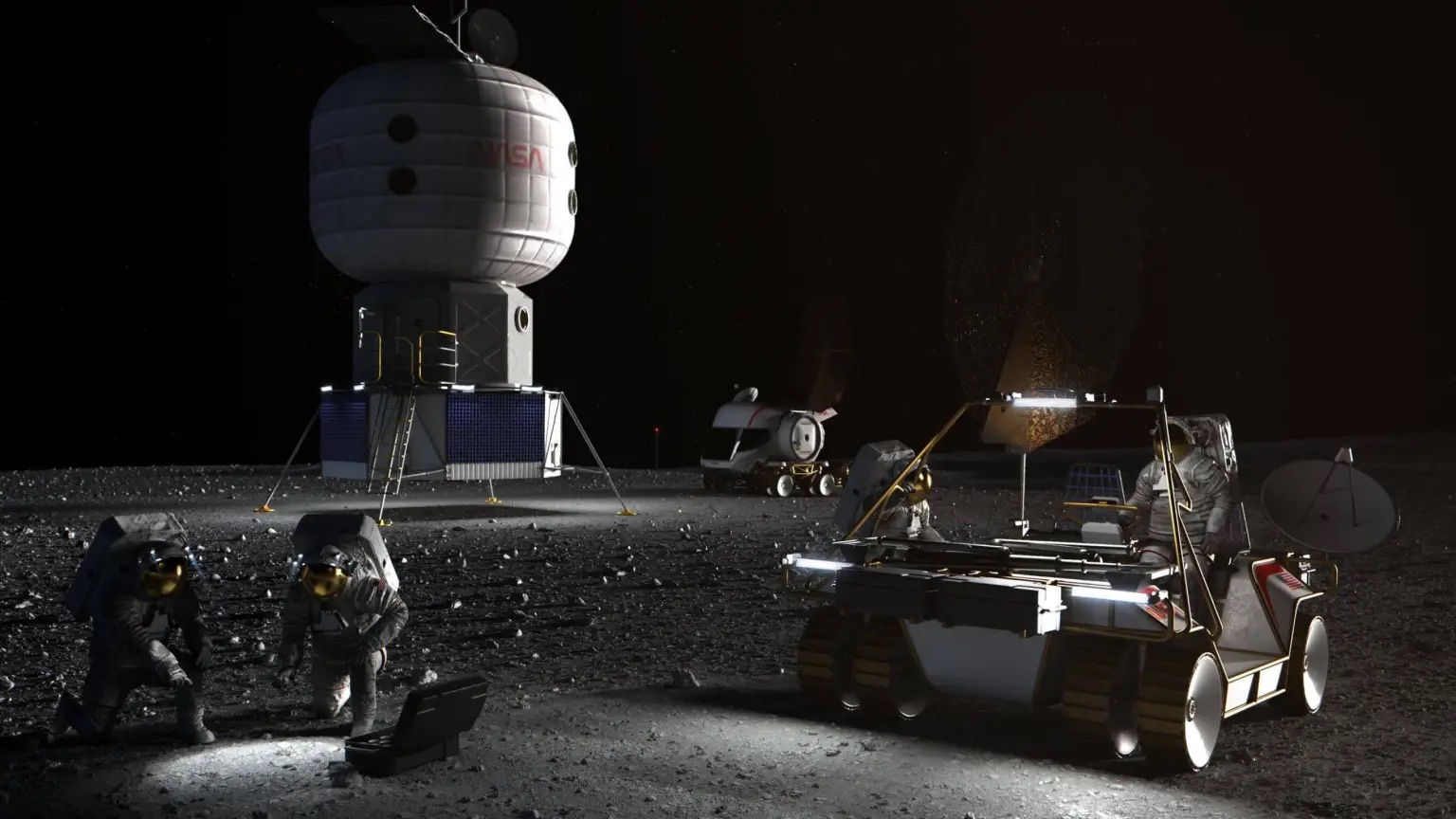
An artist’s concept of NASA astronauts working on the lunar South Pole.
Source: NASA
Early next year, four astronauts will board the Artemis II spacecraft and take off for outer space. The team will conduct a lunar flyby, making it the first crewed mission near the moon since 1972. Their research and time in space will hopefully lay the groundwork for a sustained U.S. presence on the moon.
Key to these future missions are rovers, satellites, and robotic infrastructure to conduct experiments and remain in contact with Earth.
The potential of this technology brought industry leaders to the Johns Hopkins University Bloomberg Center for a workshop focused on human-machine teaming in space, a process where people and systems share work as a team. Speakers from the Department of Commerce, the National Science Foundation (NSF), and the Johns Hopkins University Applied Physics Lab (APL) said that pairing people with robots is vital for America to achieve its long-term strategy on the moon and Mars.
“Spaceflight is very demanding—physically and mentally taxing for the human crew—is inherently risky, and requires high levels of performance from both humans and machines, including robotic assistants,” said Mark Shelhamer, Johns Hopkins professor of otolaryngology and workshop organizer. “Human-machine teaming will improve productivity and increase safety in the extreme environment of spaceflight.”
A new era of lunar activity
Today, the U.S. is focusing on establishing a sustained lunar presence, a sharp departure from the country’s previous space strategies, said Jason Kalirai, the mission area executive for space formulation at APL.
“The moon is the most visible object in the night sky, so civilizations have been looking at the moon since there have been civilizations,” he said. “Yet, it’s this generation…where the bar that we will be measured by in terms of our success is to establish a sustained human presence on the moon and to use the natural resources of that moon to sustain that presence.”
Kalirai pointed to China’s rapid pace of achievements in expanding lunar programs, including robotic missions, as a signal that the U.S. must move with speed and purpose. Human-machine teaming, he said, could be the capability that allows the country to maintain strategic leadership in an increasingly competitive landscape. For example, NASA and other space agencies are developing operations in which astronauts teleoperate robots in orbit and allow humans to oversee robotic tasks, such as docking. This showcases how these human-machine partnerships can expand capabilities.
Universities also play a key role in helping the U.S. achieve this goal, Shelhamer said.
“Autonomous human-machine teaming is a new field,” he said. “Effective implementation will require the integration of several existing technological capabilities, along with the development of new technologies. The latter is typically the domain of university research.”
Designing systems that work as an ecosystem
Despite advances in autonomy, mobility, communications, and power systems, many of these solutions remain siloed. Panelists, including Gioia Rau, program director at NSF, and Sarah Brothers, director of the commercial remote sensing regulatory affairs division at the Department of Commerce, emphasized the need for standards for how robots and humans should work together.
“The choices we make today about autonomy, data flow, workflows, and interoperability will lock in the architectures we operate within for decades,” Rau said. She encouraged viewing the moon not as a destination, but as an operating environment where multiple activities must happen simultaneously.
Similarly, Brothers added that understanding the role of humans in a machine-dominated environment is critical. While humans still play an important role in setting objectives, overseeing operations, and making high-stakes decisions, they are not embedded across every part of the system. Many supporting assets—such as satellites, sensors, and robotic platforms—operate far beyond where astronauts are physically present. Integrating humans and machines in a synergistic team across these domains is a challenge that the space community will face, experts said.
They also made clear that the future of space exploration will not be defined by humans or machines alone, but by how effectively the two can operate autonomously as a cohesive team. Human-robot teams will have to be independent from mission control on Earth to accomplish exploration goals on the moon and later on Mars, Shelhamer said. From rovers scouting lunar resources to astronauts making high-stakes decisions in real time, the synergy between humans and machines could be the backbone of the U.S.’s future space activity.
Quelle: Johns Hopkins University