
24.12.2025
HANBIT-Nano crashes due to unknown abnormality
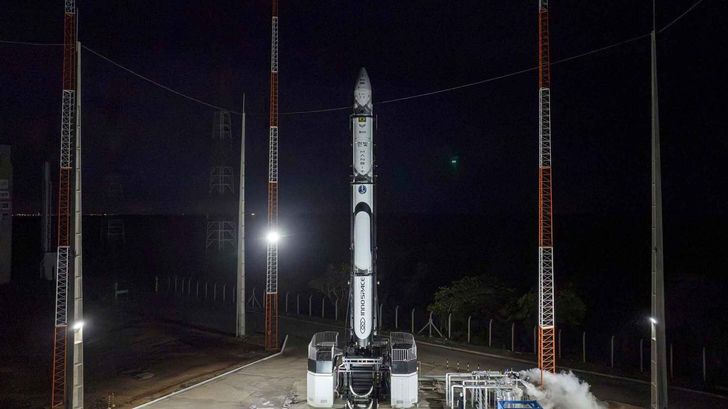
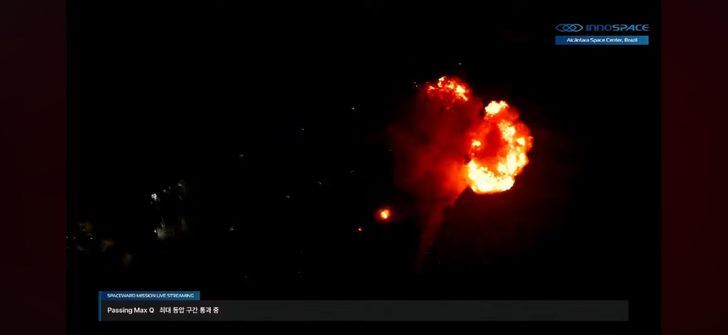
The HANBIT-Nano, Korea’s first commercial space launch vehicle, saw a successful lift-off from its launch site in Brazil on Tuesday (Korean time) but crashed shortly after due to what its operator Innospace called an abnormality.
The rocket was launched from the Alcantara Space Center at 10:13 a.m. as scheduled, beginning its vertical ascent after the successful ignition of its 25-ton-thrust hybrid rocket engine in the first stage.
After approximately 30 seconds of flight, however, an abnormality was detected in the vehicle, and it crashed into a pre-designated ground safety zone, with no casualties or additional damage reported, the company said.
Innospace said in a statement that it is “determining the cause of the mission’s termination” and “the results of its analysis will be shared later.”
Though the company did not specify, the livestream of the launch briefly showed the rocket engulfed in flames about one minute after liftoff, with the message, “Passing Max Q.”
Max Q stands for maximum dynamic pressure, which refers to a moment when an aerospace vehicle experiences maximum aerodynamic stress caused by increasing speed and atmospheric density. At that point, the HANBIT-Nano was believed to be flying at speeds faster than Mach 1.
After displaying the message, “We experienced an anomaly during the flight,” the livestream was terminated.
Innospace CEO Kim Soo-jong said in a letter to shareholders that “the company is focusing on identifying and verifying situations observed under actual flight conditions, rather than jumping into conclusions about a specific cause at this stage,” adding that the results of the analysis will be disclosed at a later date.
The mission was supposed to be Korea’s first commercial space vehicle launch, deploying a total of eight payloads into low earth orbit at an altitude of 300 kilometers. They included four client satellites from Brazil and one from India.
The launch followed a series of delays and setbacks. Innospace initially planned to launch on Nov. 23, but postponed it to Dec. 18 due to error signals detected in the ground system. The launch was again delayed to Dec. 20 because of an abnormality in the first-stage cooling system, and then to Dec. 23 following an issue with the second-stage liquid methane tank.
As Dec. 23 marked the final day of the launch window approved by the Brazilian Air Force, the company proceeded with the launch attempt. However, unfavorable weather conditions forced the launch time to be pushed back by about 13 minutes.
Immediately after the launch failure, the company’s shares on the tech-heavy KOSDAQ plunged close to the market’s 30 percent daily lower limit.
“Although the launch did not reach its planned final outcome, an important achievement was that we successfully collected flight, propulsion and operational data that can only be secured in actual flight conditions,” Kim said.
“Based on the data secured from this launch, we will carry out technical improvements and aim to attempt another commercial launch in the first half of next year.”
Quelle: The Korea Times