
23.12.2025
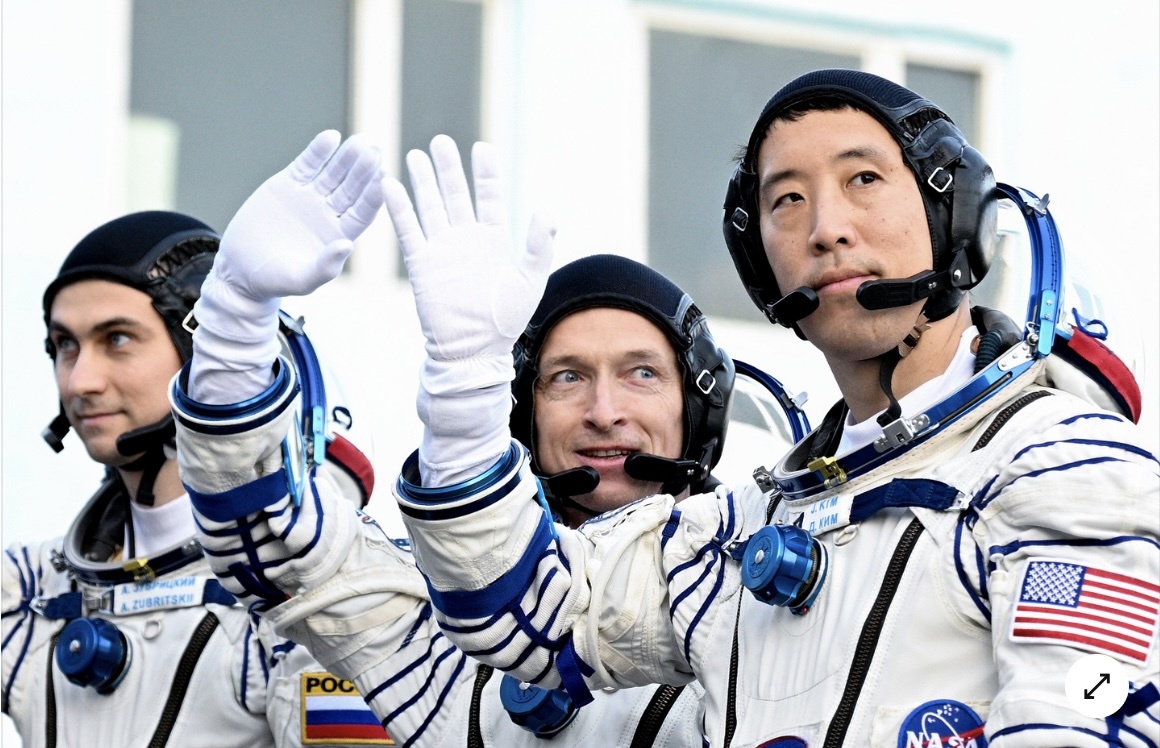
From right to left: Soyuz MS-27 crew members NASA astronaut Jonny Kim, Roscosmos cosmonauts Sergey Ryzhikov and Alexey Zubritsky are seen during a send-off ceremony prior to the launch of the Soyuz 2.1, a booster rocket with the Soyuz MS-27 spacecraft from the Baikonur Cosmodrome, at Kazakhstan on April 8. [TASS/YONHAP]
Jonny Kim has flown in space and served in war. After returning from eight months aboard the International Space Station (ISS), the NASA astronaut spoke about something closer to home: growing up between cultures, learning empathy and missing kimchi.
“Growing up as a Korean American has helped shape me into the person I am,” Kim said at a news conference on Friday at NASA’s Johnson Space Center. “I really think about empathy.”
Kim had returned to Earth on Dec. 9 after completing his first space flight mission, where he took part in scientific research and technology demonstrations.
He made the remarks in response to a JoongAng Ilbo reporter’s question about how his background influenced his life and career, noting that many children of immigrants share the experience of feeling caught between cultures.
“Like a lot of first-generation or second-generation Americans, you can kind of feel in between two worlds,” he said. “I didn’t really feel I was very Korean, or I didn’t feel I was very American. And that was hard.”
That experience, he said, shaped how he understands others. “Having those challenges for myself gave me a lot of understanding,” Kim said. “It certainly has had a strong effect on the person I am today.”
Kim linked that perspective to international cooperation in space.
“I know KASA, the Korean space agency, is just starting up and I’m very, very proud of that and I’m looking forward to that," he said, referring to the Korea AeroSpace Administration, which launched in 2024.
“I think it is reflective of the continued international collaboration that NASA has led and the benefits we can have when we work together," he added.
Kim also spoke about the food he missed while living aboard the station. “My favorites were actually sent up in my care package,” he said. “My loved ones packaged kimchi, rice and dried seaweed.”
He said the station’s standard menu offered no close alternatives to the Korean staples. “There was nothing on the menu that was even remotely close to some of those things,” Kim said. “Being able to have that little bit of home was really nice.”
He previously drew attention from Koreans by sharing images on Instagram of himself eating such food as gochujang(fermented chili paste), kimchi, Spam and instant rice.
Kim was born in Los Angeles in 1984 to a Korean immigrant family. After graduating from Santa Monica High School in 2002, he joined the U.S. Navy and served with SEAL Team 3, including two deployments to Iraq. He later attended Harvard Medical School as a Navy officer, graduating in 2016.
NASA selected him as an astronaut in 2017. He began his first space mission in April and served about eight months as a flight engineer on ISS Expeditions 72 and 73.
Kim said he has largely readjusted to life back on Earth. “I’ve been back on Earth now for a little over a week and have mostly adjusted to gravity,” he said. “It feels great to have weather again, to feel the wind against my skin.”
“It was such a huge privilege to serve NASA, to serve the public, serve science and exploration,” Kim said.
Among the mission’s scientific work, Kim highlighted research conducted in the Japanese experiment module’s life sciences glove box. He said the experiment studied bone stem cells to determine whether different conditions could reduce bone loss, research he said could be important for astronauts and for people living on Earth who are suffering from bone and musculoskeletal-related diseases.
He also described an experiment that allowed astronauts to use "joysticks and advanced controllers" to interact with robots connected to research centers around the world. The work tested whether astronauts in orbit could operate robots on the surface of a planetary body without landing.
Kim said daily life in microgravity often defies expectations. “So easy things are hard and hard things are easy in space,” he said, explaining that simple actions, such as setting objects down, become difficult while moving heavy objects can take only a finger.
When asked what he missed most during the mission, Kim cited his family and limited access to technology. “Of course, I missed my family,” he said, mentioning his wife, children and dog. “But the thing I really, really missed was unfettered access to technology.”
Kim said he enjoys exploring new tools and research freely "through a phone or the computer to the latest large language model or research or technical manuals."
“So I kind of missed my phone," he said.
Kim closed the news conference with advice for future astronauts, emphasizing interpersonal skills over technical expertise. “Most importantly, have empathy,” he said after listing the abilities to "listen, to lead and to have compassion.
“What’s important is how we treat one another.”
Quelle: Korea JoongAng Daily