
12.12.2025
"Not only are [some Chinese satellites] difficult to visually acquire, that shape, they believe, would be incredibly beneficial in terms of masses of the radar cross section," Chief Master Sergeant Ron Lerch said.
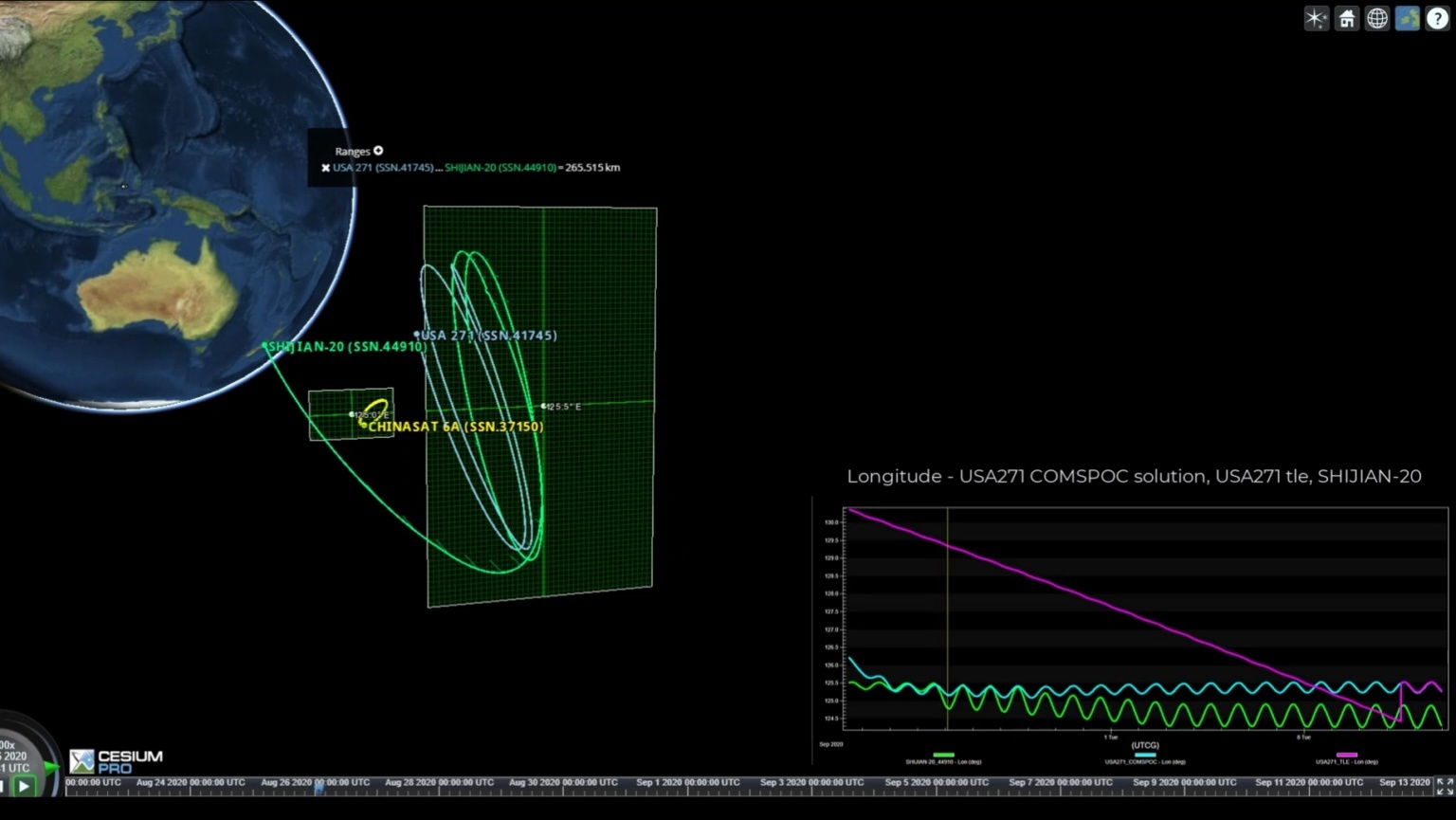
A screengrab of model encounter of an American and a Chinese satellite in space. (COMSPOC)
SPACEPOWER 2025 — China and Russia are experimenting with stealth technologies aimed at making it harder for radar and telescopes to find their satellites, according to a senior Space Force official.
“In years past, we’ve talked about this cat and mouse game that was happening at GEO [geosynchronous Earth orbit] — Chinese, Russian, US satellite, sort of stalking each other. This past year has really been more of a hide and seek game that we’ve seen at LEO [low Earth orbit],” Chief Master Sergeant Ron Lerch, senior enlisted advisor to the deputy chief of space operations for intelligence, said today.
For example, he said, the three LEO-stationed Shiyan-24 satellites (Shiyan A, B and C) involved in synchronized maneuvers that Space Force vice Gen. Michael Guetlein back in March dubbed as “dogfighting in space” each had a different radar cross section — the second being smaller than the first and third smaller still.
That suggests, Lerch told the Space Force Association’s Spacepower 2025 conference, “that the Chinese are moving forward with what we’ve seen as a decades-long plan and research to potentially use some stealth applications in space.”
Since 2012 the Chinese military also has been experimenting with shaping microsatellites to make it harder to spot them, Lerch added in response to a question from Breaking Defense on the sidelines of the conference. The PLA published a research paper in 2022showing the results: a tiny metallic satellite, known as the “Olive-B” test article, that looks like “a sphere” that has been “sitting in an anechoic chamber” undergoing lab tests, he said.
“Not only are they difficult to visually acquire, that shape, they believe, would be incredibly beneficial in terms of masses of the radar cross section,” Lerch told the conference.
Meanwhile, Russia “very recently” orbited an experimental satellite with very low visibility called Mozhayets in medium Earth orbit (MEO), Lerch said.
“What’s fascinating about the Mozhayets is that it has a very, very low visual magnitude. Just to give you some context, the Sun is a negative 26 visual magnitude. So, a negative or a lower number, the brighter. In other words … when you go to a positive number, that means that it’s dimmer,” he said. “So GPS satellites at MEO, they’ve got about a 6.5 visual magnitude. This Mozhayets satellite the Russians put up to MEO was at about a 16 for visual magnitude, very difficult to see.”
Lerch credited commercial firms for helping the Space Force identify and track these increasingly stealthy satellites, noting that without commercial data it would be impossible to discuss their activities in an unclassified environment.
According to Lerch’s slides, LeoLabs provided the information about the Shiyan birds, and Slingshot about the Mozhayets. Indeed, Slingshot actually found the Mozhayets before the Space Force did — at least publicly — according to a Nov. 17 company press release.
The Mozhayets-6, built by Russia’s Mozhaisky Military Space Academy, was launched on Sept. 13 as a rideshare on a new Russian GLONASS positioning, navigation and timing satellite, the release explained. But it spend five weeks lost in space, at least to the Space Force’s public database of on-orbit objects, Slingshot said.
Quelle: BREAKING DEFENSE