James Webb Space telescope spots 'big red dot' in the ancient universe: A ravenous supermassive black hole named 'BiRD'
"The James Webb Space Telescope has opened a new frontier in extragalactic astrophysics, revealing objects we didn't even suspect existed, and we're only at the beginning of this adventure."
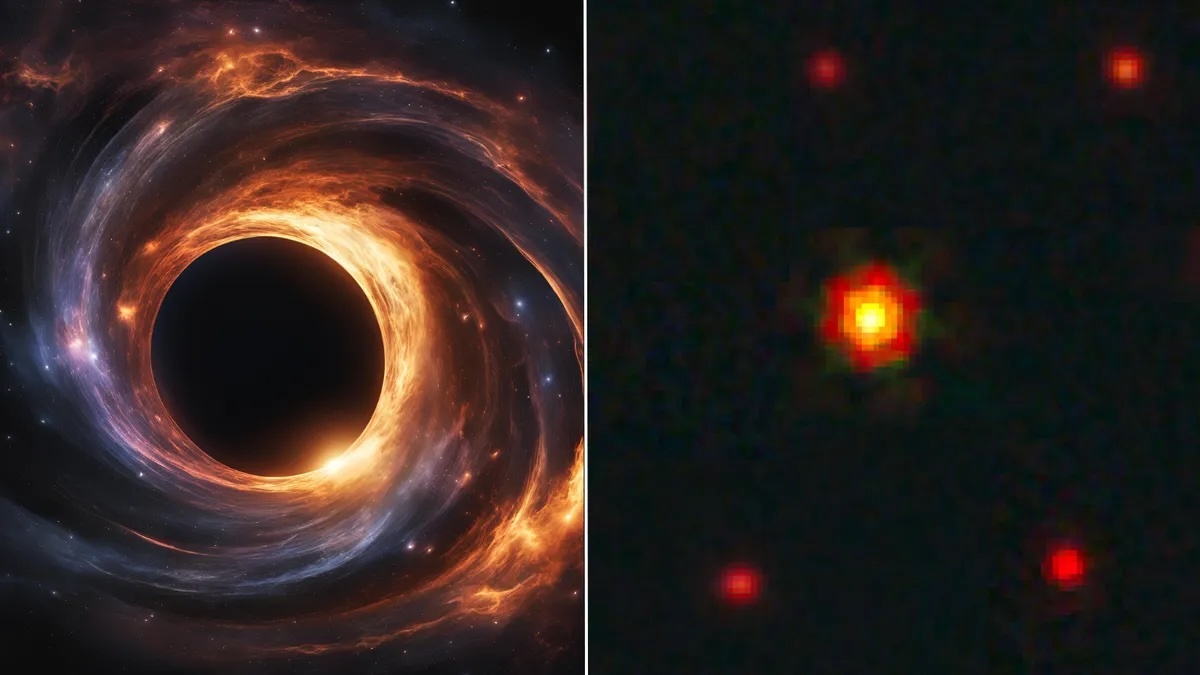
(Left): An illustration of a feeding supermassive black hole. (Right) The "red dots" identified in the region of the sky around the quasar J1030. BiRD is the object in the center: it stands out from the other red dots because it is closer and, therefore, brighter(Image credit: F. Loiacono, NASA, ESA, CSA)
Using the James Webb Space Telescope, astronomers have discovered a ravenous supermassive black hole that existed during a period of the cosmos called "cosmic noon" that occurred around 4 billion years after the Big Bang. The discovery could further shine light on the mystery of how supermassive black holes grow to sizes of millions and even billions of times that of the sun.
This black hole is part of a collection of objects the James Webb Space Telescope(JWST) has been discovering in the early cosmos called "little red dots," mysterious specks of light that were only recently discovered thanks to the incredibly powerful infrared eye of this $10 billion space telescope. However, with a mass equivalent to 100 million times that of the sun, there is really nothing "little" about this black hole at all, with the discovery team dubbing it "BiRD," which stands for Big Red Dot.
Black holes don't emit any light themselves, in fact trapping any incident light due to their immense gravitational influence, but when these cosmic titans are surrounded by a wealth of matter upon which they are feeding, this material and jets blasted out from the poles of the black holes create a very conspicuous and bright object called a quasar. These can be seen from vast distances; for example, the light from BiRD has been travelling to Earth for 10 billion years.
BiRD was spotted in the region of the sky around a previously known quasar called J1030+0524 (J1030), itself a feeding supermassive black hole located around 12.5 billion light-years from Earth. This region of the sky has been well studied by astronomers — including this team, which hails from the National Institute for Astrophysics (INAF). However, it was while carefully analyzing images and spectra obtained with the JWST's Near-Infrared Camera (NIRCam) instrument that the research team detected an unusual source of light. A bright point in infrared that had never been revealed by prior X-ray and data.
"Starting from the calibrated images, a catalog of the sources present in the field was developed. It was there that we noticed BiRD: a bright, point-like object, which, however, was not a star and did not appear in the existing X-ray and radio catalogs," Federica Loiacono, team leader and INAF research fellow, said in a statement translated from Italian. "I analyzed its spectrum, which tells us about the chemical composition and some of the physical properties of the object."
This is possible because elements absorb and emit light at specific and characteristic frequencies. This means that the elements leave their "fingerprints" in wavelengths of light, or spectra.
"We found clear signals of hydrogen — in particular the line called Paschen gamma, a luminous signature that reveals the presence of ionized hydrogen — and helium, also visible in absorption," Loiacono said. "These details allowed us to estimate the distance to BiRD, discovering that it is relatively close to us compared to most of the little red dots known to date. Also from the analysis of the spectrum of this source, we were able to estimate the mass of the central black hole: about 100 million times that of the sun."
Little red dots are very compact objects with curious spectroscopic characteristics. Many possible theories exist surrounding these bodies, including a recent suggestion that they could be a new class of celestial body called "black hole stars." One of the prevailing theories posits that little red dots are feeding and growing supermassive black holes. The problem with this concept is the fact that the region around ravenous black holes should emit strongly in the X-ray region of the electromagnetic spectrum, but that doesn't seem to be the case for little red dots or for BiRD.
One possible explanation for this is that little red dots are the massive black hole "seeds" from which supermassive black holes grow and are therefore still shrouded by thick shells of gas and dust, shrouds that absorb high-energy X-ray radiation while allowing low-energy infrared light to slip through.
But even among the known little red dots, BiRD is a strange example.
"Before BiRD, only two other little red dots with the same spectral characteristics, including helium lines and Paschen gamma rays, were known at this same cosmic distance," Loiacono explained. "Comparing the spectral properties of BiRD with those of the other two, we found strong similarities: the line widths, absorption, black hole mass, and gas density are very similar. This led us to conclude that BiRD belongs to the same family as little red dots."
In addition to the discovery of BiRD, this research could change how scientists think of little red dots and, in turn, the growth and evolution of supermassive black holes. It was previously thought that these objects would have started to disappear as cosmic noon rolled around approximately 11 billion years ago. However, this team performed a calculation estimating the abundance of little red dots during cosmic noon, finding them to still be numerous during this cosmic epoch.
"The challenge now is to extend the study to a larger number of nearby LRDs, which we can study in greater detail than distant ones, to build a more complete picture," Loiacono concluded. "JWST has opened a new frontier in extragalactic astrophysics, revealing objects we didn't even suspect existed, and we're only at the beginning of this adventure."
JWST makes 1st-ever detection of complex organic molecules around star in galaxy beyond our Milky Way
The molecules are building blocks of the chemical precursors of things such as RNA.
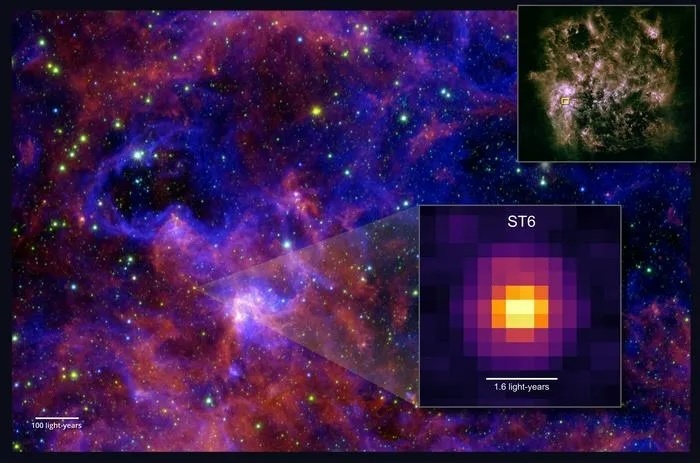
The location of the massive protostar ST6 in the star-forming region N158, close to the giant Tarantula Nebula (30 Doradus) in the Large Magellanic Cloud. The protostar still exists in a huge core of gas 1.6 light-years across. Inset is a view of the LMC seen in infrared.(Image credit: NASA/ESA/CSA/JPL-Caltech/M. Sewiło et al. (2025))
Frozen complex organic molecules have been discovered for the first time around a young protostar in a galaxy other than our own, thanks to the observing power of the James Webb Space Telescope (JWST).
Astronomers led by Marta Sewiło of the University of Maryland used JWST's Mid-Infrared Instrument (MIRI) to detect myriad complex organic molecules (COMs) in ice that encase grains of dust around the massive protostar ST6 in the Large Magellanic Cloud (LMC), which is a neighboring dwarf galaxy about 163,000 light years away. COMs are classed as carbon-bearing molecules containing more than six atoms, and many COMs are the chemical precursors to the building blocks of life as we know it.
The frozen COMs that were confirmed to exist around ST6 include acetaldehyde, acetic acid, ethanol, methanol and methyl formate. On Earth, methyl formate and acetaldehyde are used as industrial chemicals, methanol and ethanol are alcohols, and acetic acid is in vinegar. But they are also the backbone of even more complex, "second-generation" molecules that build the likes of amino acids and RNA molecules.
At least another 14 COMs were also detected by JWST, but so far Sewiło and her colleagues have been unable to confirm their identity.
"We have only just started exploring the dependence of complex organic chemistry in this environment," Sewiło told Space.com in an interview.
JWST is breaking new ground in the study of chemistry in environments where stars and, later, planets form.
Stars form when massive clouds of frigid molecular gas begin to fragment and collapse, producing dense cores where stars begin to coalesce. At first, these cores are cold, less than 100 kelvin (i.e., 100 degrees above absolute zero) and complex molecules exist as ices on dust grains. It is only later, when the core grows hotter, that the ice sublimates and releases the COMs as gases.
Whereas COMs in their gas phase have been detected multiple times around young stars in both the Milky Way galaxy and the LMC — for example, both methanol and methyl formate had previously been found in their gas phase around protostars in the LMC — they have been far harder to spot when in the earlier, cold ice phase.
"JWST has enabled the detection of COM ices, but to date there are only four protostars in the Milky Way where we have detected icy COMs, and only one in the LMC — ST6," said Sewiło.
By detecting the COMs in their frozen states, astronomers get an indication of how far evolved the chemistry of the material surrounding protostars is at the earliest stages of star formation.
Their presence around a young, massive protostar in the LMC is also intriguing, given the differing conditions there compared to our Milky Way galaxy. The LMC has properties in common with galaxies that existed when the universe was much younger, namely a lower abundance of elements heavier than hydrogen and helium and a stronger ultraviolet radiation field. The lack of heavy elements could impact the abundance of COMs, while the ultraviolet radiation could affect the rate of chemical reactions.
Therefore, understanding the organic chemistry of the LMC can also help teach us about the organic chemistry of the early universe, in particular how soon the building blocks of life were able to form. This could help place limits on how early, theoretically, life could have formed in the universe.
The dearth of heavy elements in the LMC does seem to have impacted the abundance of COMs around ST6.
Complex organic molecules have been identified in the icy mantle on dust grains around the protostar ST6 in the Large Magellanic Cloud. (Image credit: NASA’s Goddard Space Flight Center)
"The COM ice abundances with respect to water ice that we measured for ST6 are lower than those measured for the four protostars in the Milky Way for all COMs, as expected, except for acetic acid," said Sewiło. "The overabundance of acetic-acid ice is likely the result of the higher ultraviolet flux in the LMC."
Among the other 14 — at minimum — unknown absorption lines in ST6's spectrum could be glycolaldehyde, which is a chemical precursor to ribose, which is a component of RNA molecules.
"We have found evidence that several of the unidentified absorption features could be attributed to glycolaldehyde, but the detection remains inconclusive since more laboratory spectra are needed to verify it," said Sewiło, alluding to the fact that the star's spectrum is compared to those of different molecules taken in laboratory conditions to identify which absorption lines belong to which COMs.
"It is likely that more COMs are present in the ices around ST6, and our results highlight the need for more laboratory experiments."
As the protostar evolves and heats up, the ice on the dust grains nearest the star will sublimate and the COMs will move into their gas phase, as has previously been detected.
It is in the gas phase that more chemical reactions can take place, triggered by ultraviolet radiation from the protostar and the wider environment, "leading to larger and more complex molecules important for life such as propanol and propanal, and possibly amino acids, but we've not detected them in ST6 yet," said Sewiło.
Amino acids have, however, been found in comets and meteorites in our solar system. Comets and meteorites are ancient bodies, formed 4.5 billion years ago when our sun was a protostar. The implication is that amino acids are the end result of a pathway of chemical reactions that begin with the kinds of COMs discovered around ST6.
James Webb Space Telescope captures 'one-of-a-kind' triple star system that looks like a cosmic embryo (image)
"This is a one-of-a-kind system with an incredibly rare orbital period."
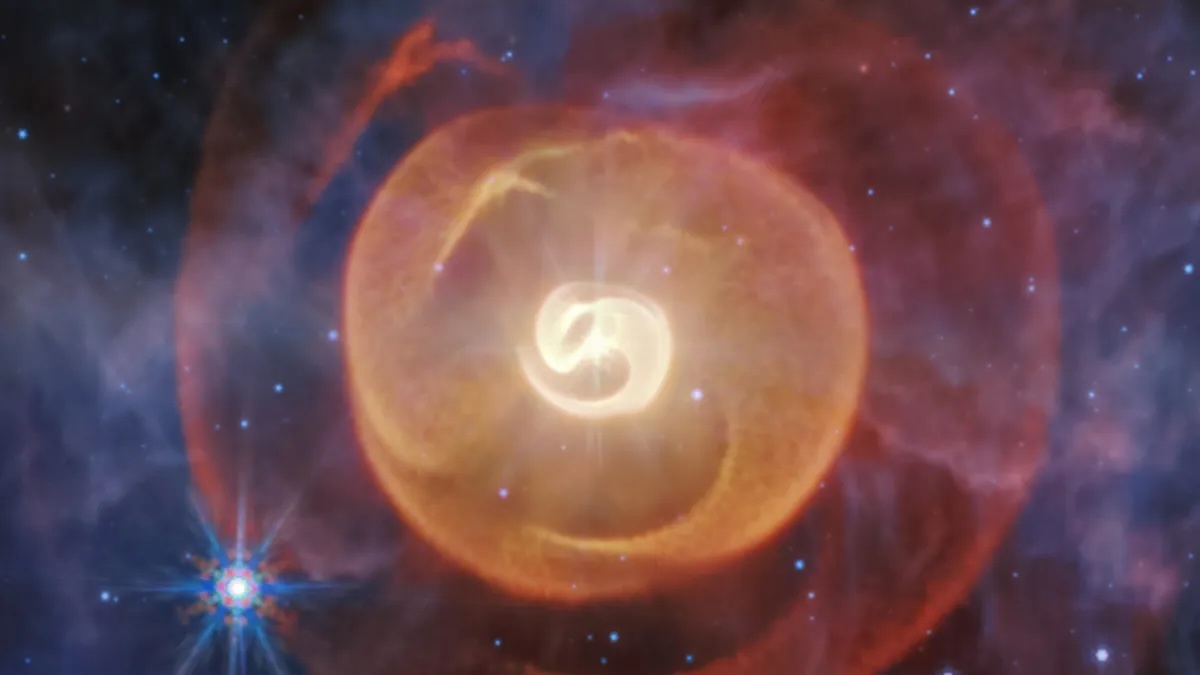
JWST's mid-infrared image of the spiraling dust shells around the triple star system Apep, which includes two Wolf-Rayet stars.(Image credit: NASA/ESA/CSA/STScI; Science: Yinuo Han (Caltech)/Ryan White (Macquarie University); Image Processing: Alyssa Pagan (STScI).)
A nested series of dusty spirals is captured swirling around a mighty triple star system containing two of the rarest stars in the galaxy in a new image from NASA's James Webb Space Telescope (JWST).
The triple system is nicknamed Apep, after the Egyptian god of chaos, and cosmic chaos. It's on dramatic display in JWST's new mid-infrared image, which makes the object look like an immense cosmic embryo. Two of the stars in Apep are Wolf-Rayet stars, which are massive and extremely hot stars that live a life bordering on instability, with powerful stellar winds carrying huge clumps of material from them, exposing a helium-, nitrogen- and carbon-rich interior. Only about 1,000 Wolf-Rayet stars are known in our Milky Way galaxy, among more than 100 billion other stars.
The material removed by the winds — not winds as we know them on Earth, but streams of charged particles — forms a nebula, and when a Wolf-Rayet star exists in a binary system with another star, the gravitational interactions between the two can sculpt the shape of that nebula. Apep, however, is unique as far as we know in that it features two Wolf-Rayet stars revolving around one another on a 190-year orbit. At closest approach, their stellar winds collide, producing dense, carbon-rich dust that forms a spiral shape over the course of 25 years each time. Each spiral then begins the journey of expanding outwards.
"This is a one-of-a-kind system with an incredibly rare orbital period," said Ryan White, a Ph.D. student at Macquarie University in Sydney, Australia, in a statement. "The next longest orbit for a dusty Wolf-Rayet binary is about 30 years. Most have orbits between two and 10 years."
When Apep was discovered in optical light in 2018 by the European Southern Observatory's Very Large Telescope in Chile, only the brightest, innermost spiral was visible, but more were suspected to exist. JWST's Mid-Infrared Instrument (MIRI) has now captured them, nested inside one another and representing four close approaches of the stars over the past 700 years or so. The outermost spiral is the faintest, on the periphery of JWST's vision.
"Looking at Webb's new observations was like walking into a dark room and switching on the light — everything came into view," said Yinuo Han of the California Institute of Technology in Pasadena, who is the lead author of one paper describing the observations, while White is lead author of another. "There is dust everywhere in Webb's image, and the telescope shows that most of it was cast off in repetitive, predictable structures."
White's study refined the orbits of Apep's stars by combining the JWST data with eight years' worth of observations by the Very Large Telescope that chart the expansion of the innermost dusty shell.
Remarkably, the images betray the presence of a third star, even more massive than the two Wolf-Rayet stars. In both the Very Large Telescope's and JWST's images, the triple star system is unresolved, looking like a single star at Apep's distance of roughly 8,000 light-years, although their exact distance is a continuing mystery.
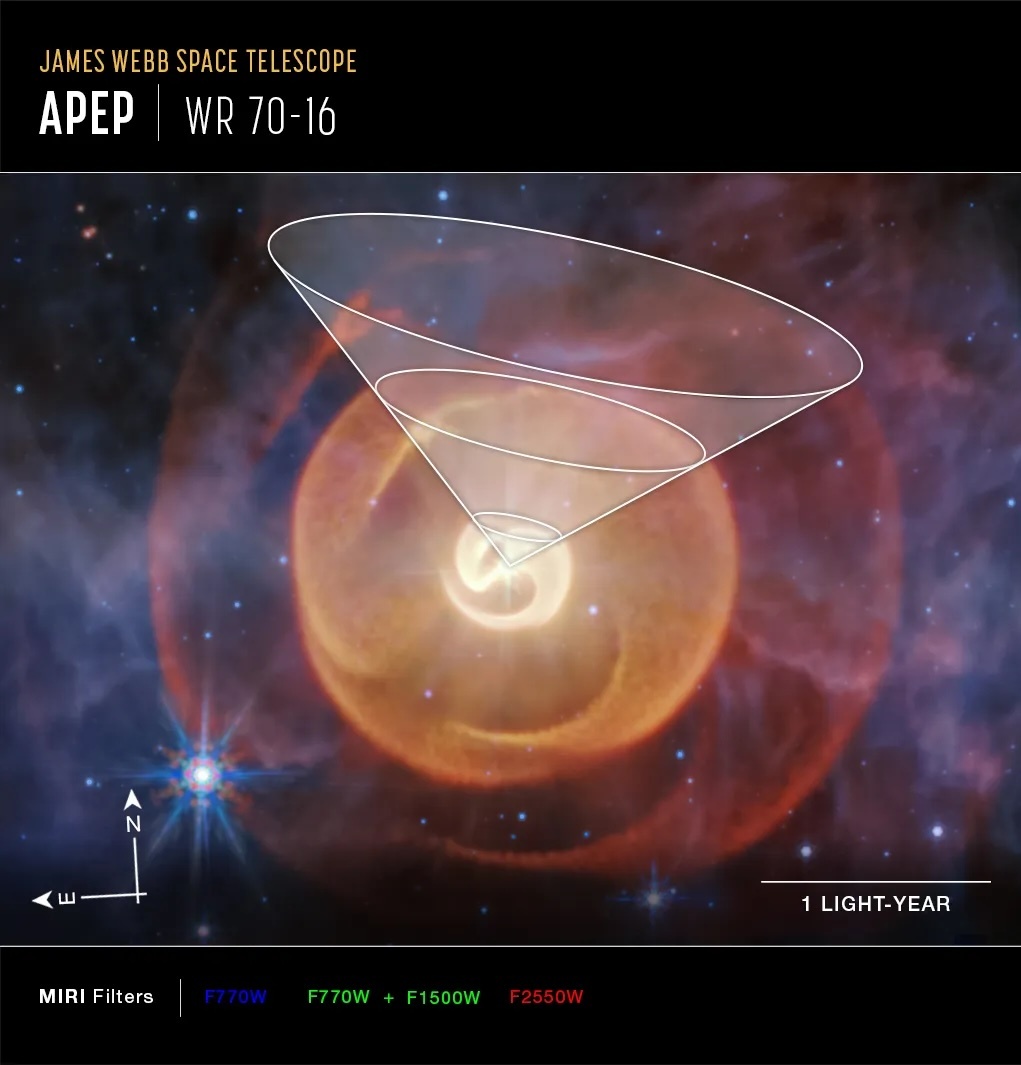
A compass image showing the size of Apep's dust shells, and the funnel shape of the cavity carved by a third star. (Image credit: NASA/ESA/CSA/STScI; Science: Yinuo Han (Caltech)/Ryan White (Macquarie University); Image Processing: Alyssa Pagan (STScI).)
While the Wolf-Rayet stars have masses between 10 and 20 times that of our sun, their triple companion is a supergiant between 40 and 50 times as massive as the sun. Its presence is revealed through the way it interacts with the stellar winds and dust from the Wolf-Rayet stars, leaving a cavity in the expanding, spiraling shells. This gap is best seen between the 10 o'clock and 2 o'clock positions in the JWST image.
"The cavity is more or less in the same place in each shell and looks like a funnel," said White.
All three stars are destined to explode as a supernova, the two Wolf-Rayet stars possibly going boom as gamma-ray bursts leaving behind stellar-mass black holes that will be orbited by a neutron star left behind when the more massive supergiant explodes.
Both papers were published Wednesday (Nov. 19) in The Astrophysical Journal, with Han's paper found here and White's paper here.
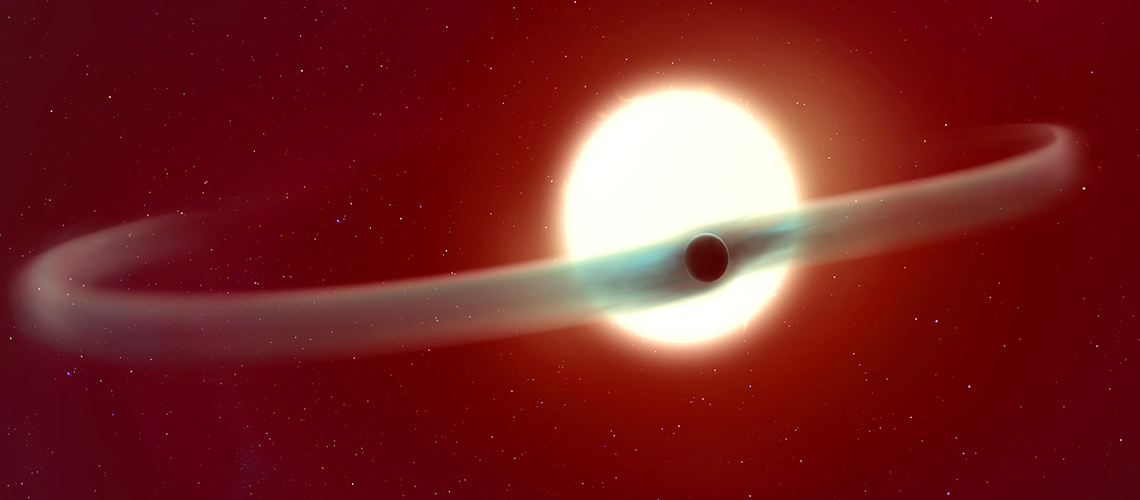
Astronomers from the University of Geneva (UNIGE), the National Centre of Competence in Research PlanetS, and the Trottier Institute for Research on Exoplanets (IREx) at the University of Montreal (UdeM) have made a striking discovery using the James Webb Space Telescope (JWST). For the very first time, scientists have continuously monitored the atmosphere escaping from an exoplanet throughout a complete orbit. The result: the gas giant WASP-121b is surrounded not by one, but by two immense helium tails extending over more than half of its orbit around its star. These observations, combined with numerical models developed at UNIGE, provide the most detailed portrait ever obtained of the atmospheric escape phenomenon, a process capable of profoundly transforming a planet over time. The results are published in Nature Communications.
A member of the ultra-hot Jupiter family, WASP-121b is a massive gas giant that orbits so close to its star that its revolution lasts only 30 hours. The star's intense radiation heats its atmosphere to several thousand degrees, allowing light gases like hydrogen and helium to escape into space. Over millions of years, this slow atmospheric escape can alter the planet's size, composition, and future evolution.
Until now, scientists had only obtained brief glimpses of these atmospheric flows during planetary transits—those few hours when the planet passes in front of its star. Without continuous monitoring, it was impossible to know how far these flows extended or how they changed.
Using the Near-Infrared Spectrograph (NIRISS) on the James Webb Space Telescope, scientists observed WASP-121b for nearly 37 consecutive hours, covering more than one complete orbit. This is the most comprehensive continuous observation ever made of the presence of helium on a planet.
We were incredibly surprised to see how long the helium escape lasted.
Two huge tails of gas
By tracking the absorption of helium atoms in the infrared, scientists discovered that the gas surrounding WASP-121b extends well beyond the planet itself. The signal persists for more than half of its orbit, making it the longest continuous detection of atmospheric escape ever observed.
Even more remarkable: the helium particles form two distinct tails. A trailing tail, pushed back by radiation and the stellar wind, and a leading tail, curved in front of the planet, likely pulled toward the star by its gravity. Together, these two flows cover a distance equivalent to more than 100 times the planet's diameter, or more than three times the distance between the planet and its star.
"We were incredibly surprised to see how long the helium escape lasted," explains Romain Allart, a postdoctoral researcher at the University of Montreal, former doctoral student at the University of Geneva, and lead author of the paper. "This discovery reveals the complexity of the physical processes that sculpt exoplanetary atmospheres and their interaction with their stellar environment. We are only beginning to discover the true complexity of these worlds."
The digital models of the University of Geneva
The Department of Astronomy at the University of Geneva (UNIGE) is at the forefront of atmospheric escape research. The numerical models developed there, for example, enabled the interpretation of the first helium observations with the JWST. These models can explain simple, comet-shaped tails, but they struggle to reproduce the double structure observed on WASP-121b. "This discovery indicates that the structure of these flows results from both gravity and stellar winds, making a new generation of 3D simulations essential for analyzing their physics," explains Yann Carteret, a doctoral student in the Department of Astronomy at the Faculty of Science of UNIGE and co-author of the study.
The next steps for WASP-121b and beyond
Helium has become one of the most powerful tracers of atmospheric escape, and the JWST's unique sensitivity now allows it to be detected over unprecedented distances and durations. Future JWST observations will be crucial in determining whether the double-tailed structure observed around WASP-121b is unique or common among hot exoplanets. Scientists also need to refine their theories to better understand this structure.
"Very often, new observations reveal the limitations of our numerical models and push us to explore new physical mechanisms to further our understanding of these distant worlds," concludes Vincent Bourrier, lecturer and researcher in the Department of Astronomy at the Faculty of Science of the University of Geneva and co-author of the study.
Quelle: University of Geneva
+++
James Webb Space Telescope opens new window into hidden world of dark matter
ASU astronomers explore the mysteries of dark matter in ways never before possible
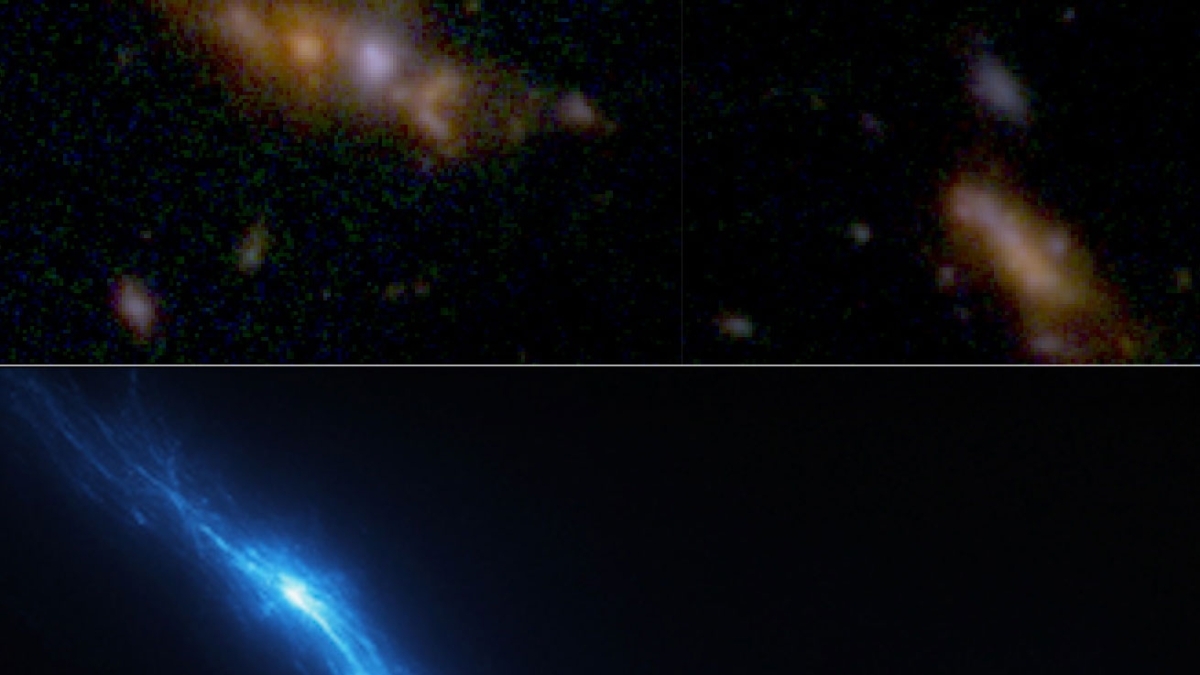
This image shows two galaxies from the JWST JADES survey seen in the first 1.8 billion years after the big bang. Image simulation courtesy of Pozo et al. team
NASA’s James Webb Space Telescope (JWST) has revealed unparalleled details about the early universe: observations of young galaxies with unexpectedly elongated shapes that challenge established cosmological models.
This discovery represents a massive leap toward a new understanding on the nature of dark matter — the invisible substance that makes up the universe’s mass. By analyzing cold, warm and wave dark matter models through state-of-the-art simulations, JWST is transforming perceptions of the early cosmos.
The recent observations revealed many never-before-seen young galaxies that formed less than a billion years after the big bang. These galaxies appear strikingly elongated, unlike the familiar disk and spheroidal galaxies seen nearby today.
A new paper — published in Nature Astronomy — describing how these peculiar forms may hold vital clues to the true nature of dark matter was led by Álvaro Pozo of the Donostia International Physics Center and included Arizona State University co-author Rogier Windhorst.
“In the expanding universe defined by Einstein’s theory of general relativity, galaxies grow over time from small clumps of dark matter that form the first star clusters and assemble into larger galaxies via their collective gravity,” said Windhorst, a Regents Professor in ASU’s School of Earth and Space Exploration and an interdisciplinary scientist for the James Webb Space Telescope.
“But now Webb suggests that the earliest galaxies may be embedded in marked filamentary structures, which — unlike cold, dark matter — smoothly join the star-forming regions together, more akin to what is expected if dark matter is an ultralight particle that also shows quantum behavior.”
To understand the origin of these unusual shapes means running simulations that show how the first galaxies formed in the early universe. Until now, astronomers have generally agreed that the earliest stars and galaxies formed when cool, pristine gas collected along a web of dark matter filaments. However, even the most advanced simulations based on the standard cold, dark matter model have struggled to reproduce the substantial elongation observed in the latest JWST images.
To investigate further, the study compares simulations that use alternative forms of dark matter: warm and wave dark matter, based on ideas involving sterile neutrinos and light axions from string theory. Wave dark matter simulations are particularly demanding because they require extremely fine resolution to capture tiny wave-like patterns while also modeling gas behavior.
“If ultralight axion particles make up the dark matter, their quantum wave-like behavior would prevent physical scales smaller than a few light-years to form for a while, contributing to the smooth filamentary behavior that JWST now sees at very large distances,” Pozo said.
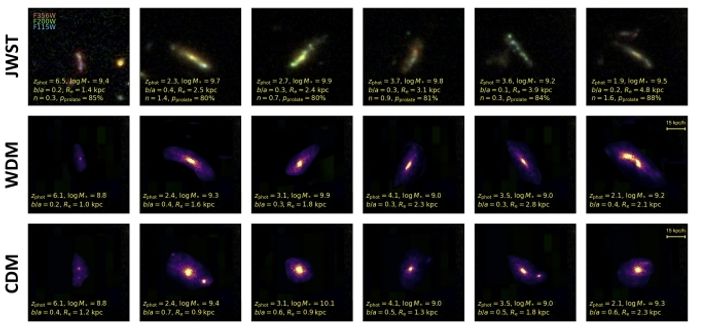
A montage of six galaxies seen between 0.85 (z_phot = 6.5) and 3.5 (z_phot=1.9) billion years after the big bang. The top row shows examples of the marked filamentary galaxies in JWST images. The middle row shows the warm dark matter simulations in the 2025 Pozo et al. Nature Astronomy paper of example galaxies that most resemble the galaxies actually observed by JWST in the top row. The bottom row shows the cold dark matter simulations of these same galaxies as observed in the top row. Images courtsey of Pozo et al.
The research team, which included experts from MIT, Harvard and Taipei, concluded that elongated young galaxies are abundantly produced in both the warm and wave dark matter scenarios, due to the smoother structure of cosmic filaments in these cases. Gas and stars flow steadily along such filaments, giving rise to prolate, elongated galaxy shapes.
This comparison can be further tested with future JWST observations, including spectroscopy, and with larger simulation volumes, potentially leading to decisive new insights into the still-unknown nature of the dark matter that dominates the universe.
This release was written by the Donostia International Physics Centerpress team with contributions from Kim Baptista of ASU’s School of Earth and Space Exploration.
In memory of George F. Smoot
The research team dedicates this work to friend and mentor George Smoot, whose invaluable wisdom significantly contributed to this collaborative paper and will leave a lasting impact. He passed away shortly after the paper was accepted.
In connection with the new research, the team would like to highlight that Smoot was among the first to take the light axion interpretation seriously. More broadly, he inspired all of his colleagues through the breadth and depth of his understanding and his unwavering pursuit of fundamental questions across the entire field. This commitment is evident in his ongoing development of quantum detectors for astronomy, as well as his theoretical applications of general relativity to interpret gravitational wave events and understand the nature of dark matter.
Quelle: Arizona State University
----
Update: 15.12.2025
.
The monster hiding in plain sight: JWST reveals cosmic shapeshifter in the early universe
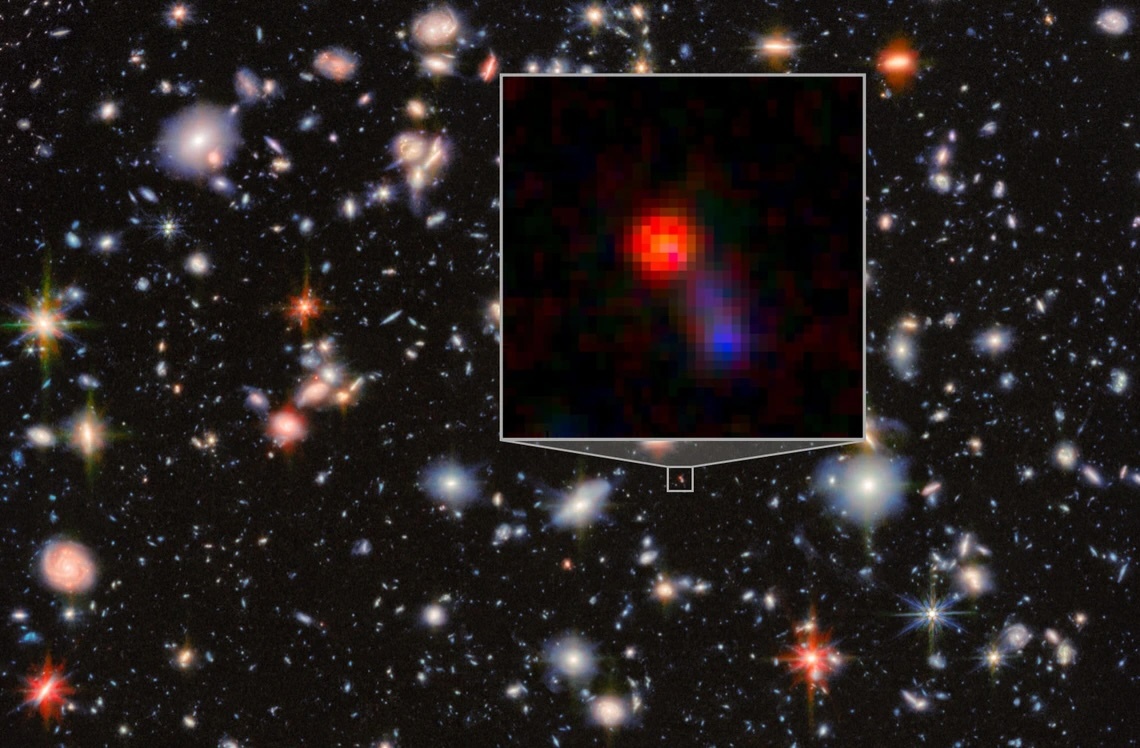
Covering a tiny patch of sky spanning less than a tenth of the full moon, the famous "Hubble eXtreme Deep Field" image revealed thousands of galaxies, including objects from the universe infancy. The James Webb Space Telescope observed the same region over three years. U of A researchers zoomed in on the galaxy reported in this study (inset), captured when the universe was only 800 million years old. The team found that even at its young age, it already harbored a supermassive black hole, shrouded in dust.
ESA/Webb, NASA & CSA, G. Östlin, P. G. Perez-Gonzalez, J. Melinder, the JADES Collaboration, M. Zamani (ESA/Webb)
In a glimpse of the early universe, astronomers have observed a galaxy as it appeared just 800 million years after the Big Bang – a cosmic Jekyll and Hyde that looks like any other galaxy when viewed in visible and even ultraviolet light but transforms into a cosmic beast when observed at infrared wavelengths.
This object, dubbed Virgil, is forcing astronomers to reconsider their understanding of how supermassive black holes grew in the infant universe.
The discovery, led by University of Arizona Steward Observatory astronomers George Rieke and Pierluigi Rinaldi (now with the Space Telescope Science Institute) and published in The Astrophysical Journal, examines a known galaxy named Virgil, but exposes its hidden nature: a supermassive black hole in the galaxy's center accreting material at an extraordinary rate, with its energy output obscured by thick veils of dust. The inferred black hole mass is far larger than its host galaxy should be able to support, placing Virgil among the so-called "overmassive" black holes that challenge current models of how black holes formed in the early universe.
The discovery challenges prevailing theories about how supermassive black holes and galaxies grew together. Before NASA's James Webb Space Telescope, astronomers believed that galaxies formed first and gradually nurtured black holes in their cores, with both growing in lockstep over cosmic time.
"JWST has shown that our ideas about how supermassive black holes formed were pretty much completely wrong," said Rieke, a Regents Professor of astronomy and a pioneer of infrared astronomy. "It looks like the black holes actually get ahead of the galaxies in a lot of cases. That's the most exciting thing about what we're finding."
Virgil belongs to a mysterious class of objects astronomers call Little Red Dots, or LRDs. The expansion of space between us and distant cosmic objects stretches their light, shifting it toward red, or longer, wavelengths by the time it reaches us.
LRDs are a group of compact, extremely red sources discovered by JWST that have sparked debate among astronomers. These luminous dots appeared in large numbers around 600 million years after the Big Bang, only to all but disappear about 1.5 billion years later. Theories to explain them range from star formation to exotic physics such as matter-antimatter annihilation.
Virgil is the reddest object in the entire Little Red Dot population discovered to date. If Little Red Dots formed in abundance in the early universe, what did they become? Nothing can leave our universe, so their descendants must exist somewhere today. This latest discovery advances the scientific community's understanding of early black hole evolution and might point toward a potential solution to the mystery.
The discovery also puts U of A-led technology in the spotlight. Virgil's true nature only became apparent through observations with JWST, specifically its Mid-Infrared Instrument, or MIRI, for which Rieke is the Science Team Lead. When using data from only JWST's Near Infrared Camera, or NIRCam, or Near-Infrared Spectrograph, or NIRSpec – both of which cover only up to the optical wavelengths in the early universe – astronomers would classify Virgil as an entirely ordinary star-forming galaxy.
The paper shows that some of the universe's most extreme objects may be hiding in plain sight – detectable only when tuning instruments to detect infrared wavelengths, which is a light spectrum invisible to the human eye. These longer wavelengths exist where dust-shrouded phenomena reveal themselves.
"Virgil has two personalities," said Rieke. "The UV and optical show its 'good' side – a typical young galaxy quietly forming stars. But when MIRI data are added, Virgil transforms into the host of a heavily obscured supermassive black hole pouring out immense quantities of energy."
"MIRI basically lets us observe beyond what UV and optical wavelengths allow us to detect," said Rinaldi, who focused his doctoral research on MIRI observations. "It's easy to observe stars because they light up and catch our attention. But there's something more than just stars, something that only MIRI can unveil."
The implications extend beyond individual objects like Virgil. Many high-redshift surveys with JWST obtain deep imaging with NIRCam but only short exposures ("shallow observations") with MIRI, due to the considerable time required to gain a deeper view. The longer the total exposure time, the more sensitive the imaging, allowing very faint or distant objects like Virgil to come into view.
This means astronomers may be systematically missing a hidden population of dust-obscured black holes that could play a significant role in cosmic history – potentially even contributing to the reionization of the universe during cosmic dawn: the turning point around 100-200 million years after the Big Bang "when the universe decided to light up with stars," Rinaldi said.
Remarkably, no other source with Virgil's extraordinary traits has been reported at such early cosmic times. But the team suspects this may reflect observational limitations rather than true rarity. "Are we simply blind to its siblings because equally deep MIRI data have not yet been obtained over larger regions of the sky?" Rinaldi asked.
The team looks forward to making further deep MIRI observations in the future, which would reveal whether Virgil is truly alone or represents the tip of an iceberg. "JWST will have a fascinating tale to tell as it slowly strips away the disguises into a common narrative," said Rinaldi.